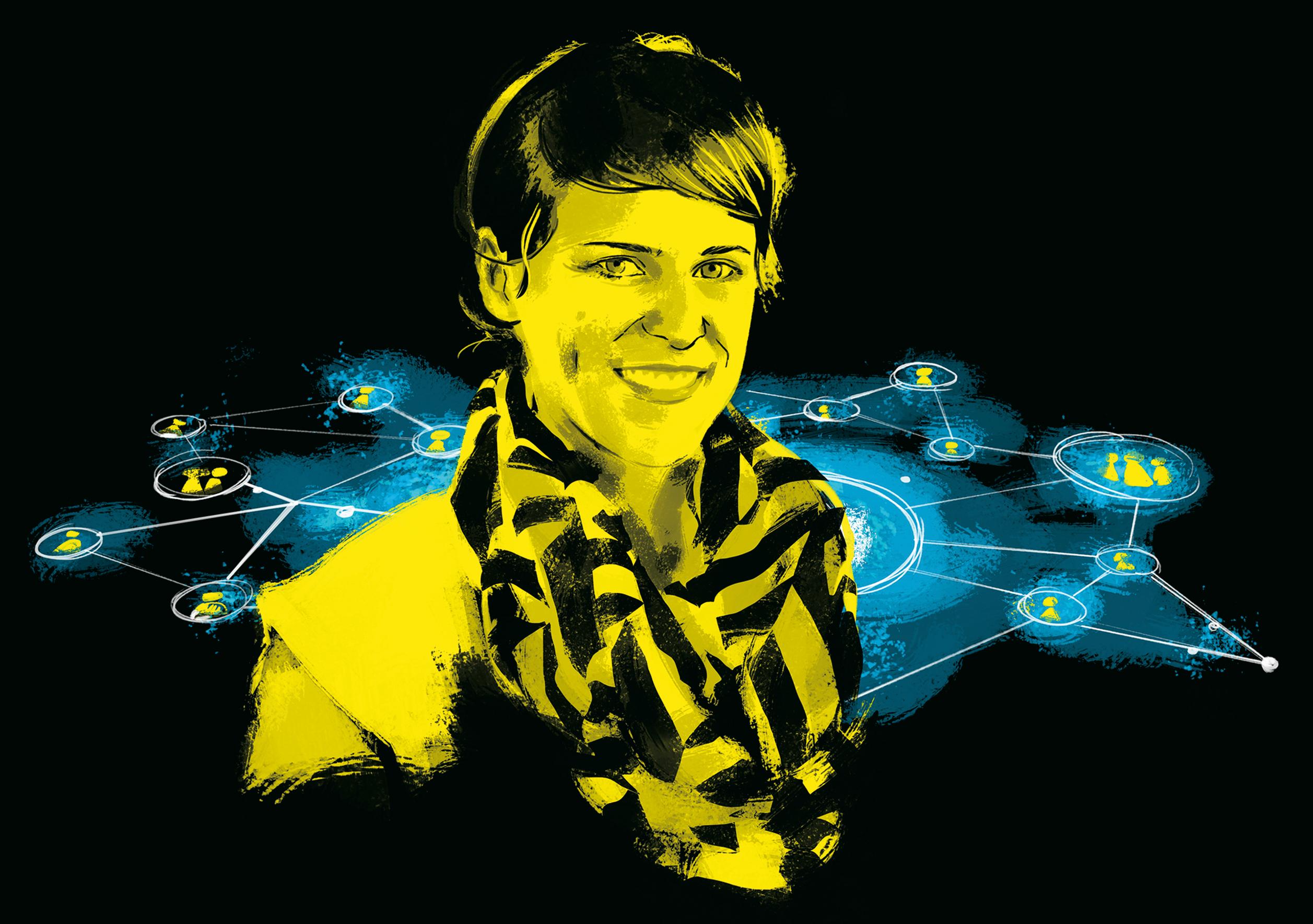
Markus Gross manages the Disney Research Studios in Zurich. He is also a computer science professor at ETH Zurich and turns the transfer of knowledge and technology into great cinema. Interviewed by Jost Dubacher, he talks about animation technologies, his role as an ETH influencer, and universities rankings.
 Mr Gross, when will we be greeted in the dealership or the furniture store by empathetic avatars?
How many customers would appreciate that is an open question. Technically, however, it is already possible. That’s why two of my employees have become self-employed – their company Animatico develops self-learning digital characters for the retail and hospitality industries. The screen avatars receive the visitors and interact with them. They infer the wishes of their human visitor from what is said and the tone of voice. We’re talking about smart displays here; screens that connect spontaneously to the viewer.
One of Animatico’s co-founders is Pascal Bérard. Until recently, he was still in the doctoral programme at ETH and worked on projects for DisneyResearch|Studios (DRS). What was his job there?
Do you know the Stars Wars episode ‘The Force Awakens’? There, a pirate princess named Maz Kanata appears: the character is completely computer-animated, but to the viewer her eyes are indistinguishable from human eyes. They were animated with software developed by Pascal. In 2017, Forbes magazine put him on its list of the best European scientists under 30 for this achievement.
Your Computer Graphics Laboratory (CGL) has been working with Disney since 2008. How did that come about?
The most important prerequisite was the acknowledged technical excellence of ETH and the good reputation of our laboratory. Add to that the high quality of life in Zurich. Disney is looking for the best talent in the world, and you get that only when potential employees see that they will feel at home somewhere. And then there were some personal contacts...
Which you brought into play?
I knew Ed Catmull, co-founder of Pixar. After Disney’s acquisition of Pixar, Ed moved to the company’s executive floor and Steve Jobs to the board of directors. There he pleaded to set up research laboratories for Disney worldwide. We won in the end along with Pittsburgh. Disney’s positioning is a godsend for us.
How does the collaboration with Disney work in daily life?
DRS employs 50 scientists and engineers within walking distance of ETH. About 30 doctoral students and postdocs work here at the CGL. I run both facilities. In addition, a changing number of ETH doctoral students are involved in DRS projects. The intellectual property stemming from this collaboration – more than 100 patents over the past decade – is shared by Disney and ETH.
Your lab’s knowledge is commercialised not only by Disney, but also by 10 spin-offs. Do you remember the first one?
Of course. That was 20 years ago now. Cyfex builds and markets CAD applications for medical technology. The software generates precise models from 3D images of a middle ear or a tooth; for example, for dental prostheses or ear moulds for hearing aids. Globally, 30,000 laboratories use Cyfex tools.
A crucial year for you was 2008, and not only because of the Disney collaboration. What happened?
That year, we put Wavelet Turbulence online. The open-source software generates explosion and smoke effects highly realistically. It hit the film industry like the proverbial bomb. Shortly after the publication, it was used in the production of the blockbuster Avatar. Today, it is considered an industry standard.
How do you animate explosions?
Everything stems from the physics. It is important to understand what goes on in the sudden release of large quantities of energy: temperature, pressure, airflow, particles, velocity. This requires physical flow equations of high mathematical complexity. That’s why we had to simplify. We calculated the explosion in low resolution and added the details for the turbulence afterwards. It’s these little whirlwinds that make the explosions cool. At the same time, we always had our goal in mind: we produce tools for animation artists. An explosion should look real on the screen, but should not cost too much in the production process.
What make computer animation expensive?
The computing power. It takes several hours of processor time for a single image in an animated movie.
The Academy of Motion Picture Arts and Sciences awarded you a Scientific and Technical Award for Wavelet Turbulence. Earlier this year, it won its second Sci-Tech Oscar. For what?
The Medusa project is about ‘motion capture’, the creation of 3D models of real faces and their movement over time. This process gives us two challenges: first, the skin reacts to light such as water or snow – it reflects a storm of light protons. Second, the acceptance of artificial figures does not increase linearly – from the cartoon character to the likeness of a person, as it were. If a digital avatar becomes too humanoid without being perfect, it creates a kind of revulsion – the ‘uncanny valley’ effect. We have overcome this eeriness with Medusa. The fairies in the 3D fantasy spectacle Maleficent are 100% synthetic, but they take the viewer on an emotional journey.
Which emotions are the most difficult to animate?
A good question. Feelings such as disgust or shock are the same usually in everyone. That makes the job easier. Anything related to humour is tricky, because jokes often have a cultural background. Basically, we as developers need to understand how people express and perceive emotions. We also collaborate with experimental psychologists to create and optimise this reality model.
CatchEye, one of your institute’s more recent spin-off projects and TOP 100 startup 2017, uses animation technology to improve videoconferencing. How exactly does that work?
Conversations on Skype or Facetime suffer because participants are not able to make eye contact. Claudia Plüss and Jan Rüegg have developed a software module that processes the live images of video conferences in such a way that the participants get the impression that the other person is looking at them. A big step forward, because we all know that the eyes play a key role in building interpersonal relationships of trust.
How do you relate to ‘your’ spin-offs?
Generally, I am invested a little, but I rarely sit on the board. I contribute my knowledge and relationships, so I’m a kind of business angel. At the same time, my experience and the various exits that I have been through give some credibility to investors. I use that for the benefit of our spin-offs.
How important is it to you personally that according to an important university ranking, ETH has overtaken the University of Cambridge for the first time?
Rankings are becoming more important, so in this respect, it fills us with satisfaction. On the other hand, it does not matter so much whether you are first, second or fourth – you can not win the Champions League every year. What’s more decisive for us, and Zurich as a location, is that we have been among the top 10 for years.