



Five Venture Leaders will represent Switzerland at MWC Barcelona this month. In the fourth interview with the team, meet Eugenia Balysheva, chief executive of Dotphoton AG, and learn how the former pro-photographer plans to break the bottleneck blocking AI for health.
Dotphoton uses quantum physics to compress image files without distortion. The company, which participated in the International Telecommunication Union's focus group on artificial intelligence for healthcare, wants its lossless compression software to let research hospitals and biotech labs store and share machine-readable images more easily.
How many photographs do you take a day?
When I was a photographer, thousands. Now, on a regular day, maybe five. But if the environment is interesting, then I can still end up with a couple of hundred.
What's the favorite picture you took in the past year?
A portrait of my kids, and one of the streets in Paolo Alto, California. It’s more symbolic than artistic, since last year we started our journey to Silicon Valley – thanks to Venturelab and Swisscom.
Dotphoton developed a lossless compression software. At what stage is the company today?
We've finished testing and proof-of-concept. We proved our technology works in mobile and have our first clients. Last year we focused on discovering the challenges the market really wants to address, where it's headed, and where our best product-market fit is. We are targeting biotech, because AI will truly change healthcare. Every single biotech research lab has its own process for image acquisition and processing. We want to create a product to suit all of them.
Why do biotech labs need image compression software?
We speak about AI being great for the development of healthcare, the problem is healthcare isn't digitalized yet – there's a bottleneck with the data. This is what we're trying to bypass, by offering the highest possible compression ratio while keeping all the relevant information in the image. There are two important benefits: first, we reduce the volume of data making it easier to store and share; second, we prove there are no artifacts – no errors in the image – so machines can read the data.
There are 3,000 hospitals in Europe. Five digitize their image data. Why? Because it's far, far too much data: this volume of data is very difficult and expensive to transmit and store.
In research, a single microscope image could be 20 terabytes. For comparison the external hard drives a normal person might use to back-up files are one to two terabytes, so for one image – for example the 3D light microscopy image of a fly's brain – you would need at least ten of these.
A research hospital’s histopathology lab will create about one petabyte of data every few months, and imagery-intensive labs will devote 56 percent of their IT budget to storage.
What’s wrong with current compression technology?
Jpeg compression was trained for the human eye, by asking loads of people whether an image looked distorted or not. Today, more machines than humans look at images. Jpeg isn't suitable for them, because there are big artifacts that lead machines to draw the wrong conclusions about an image. Dotphoton's compression is equally suitable for machines and humans.
What’s the path to lab technicians?
We know the photographer community very well and our compression product for professional photographers will help us get into biotech labs by spreading the word among enthusiasts. If you speak with the guys who work with images in the aerospace industry or the biotech industry, you discover that 90 percent of them are also amateur photographers. The amateur-photographer route is a nice way to build trust. For compression technologies, the lack of trust is the biggest barrier to entry.
We want potential lab-users to have an opportunity to try our technology privately, to see our compression keeps the detail of raw image, and how it handles. Data is the most precious part. Our process is certified: all image information stays within the image, there is no image information loss. We need people to see that for themselves.
What do you know about MWC?
There are a lot of people. When the general public hear mobile in the title, they may think it's only about phones, for me it's more about the future of technology. If you look at telecos, they're all interested in IoT and self-driving cars, because they know the way we communicate is changing and that mobile is moving more to B2B, from B2C. Since Dotphoton is aiming to be the technology of the future, it's important for us to be there.
Who would you like to meet?
Our existing partners and telemedicine companies. I’d also love to meet Light Labs Inc., who're making a 16-lens camera with interesting processing.
How is being an entrepreneur different from a regular job?
It's always on your mind! You can't switch it off, not during holidays, not at night, not at weekends. You're always thinking about the company. It's a huge responsibility, and also a huge joy. It's what drives me – that there's something this important that keeps me awake at night. But it doesn't make me feel tired, it makes me feel very resourceful. I have to bring the resources to the team.
Are you fundraising?
We aim to raise a seed round of 2 million francs in the second-quarter. We already have some commitments linked to milestones that we'll hopefully meet in the next few months. It'd be interesting to add one or two new investors with specific knowledge of our field.
We’ll use the investment to hire the team to replicate our photographer product for biotechnology labs, while trying to keep a balance in the number of business and research staff.

You took part in Venture Leaders Technology's roadshow to Silicon Valley. How was it?
Silicon Valley was absolutely amazing, I started to understand what an investor expects, their interests and the key points to win them. Venturelab organized very high-level meetings, with the key opinion leaders among investors. It was particularly interesting to hear their views and comments on how the market is developing. It really helped to shape how and when we want to raise money, and what we want to achieve when fundraising.
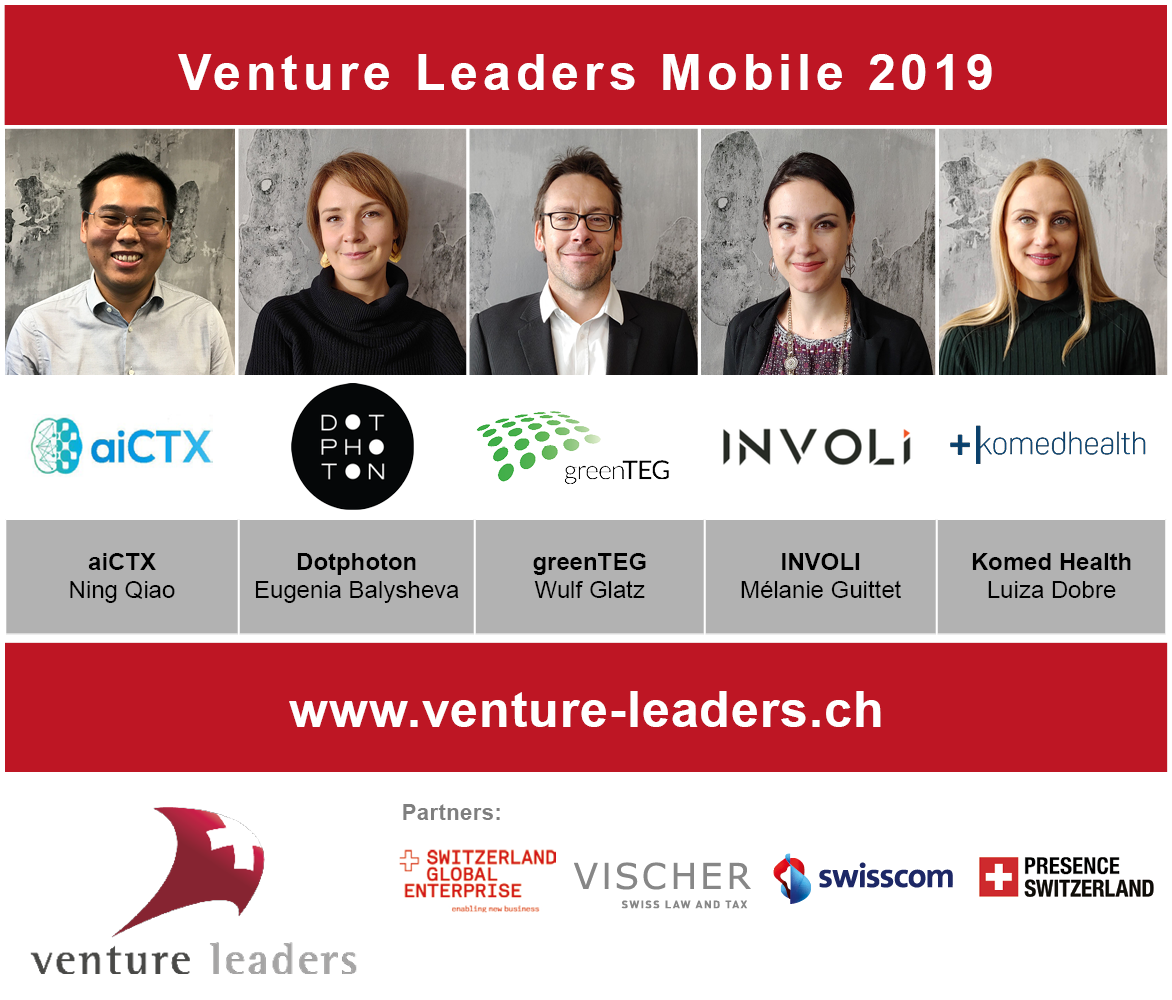
The Swiss National Startup Team's roadshow to MWC Barcelona is organized by Venturelab in cooperation with Switzerland Global Enterprise, VISCHER, Swisscom and Presence Switzerland.
Follow the Venture Leaders Mobile roadshow (February 24th to 28th) on social media using the hashtags #VleadersMobile #SwissTech.