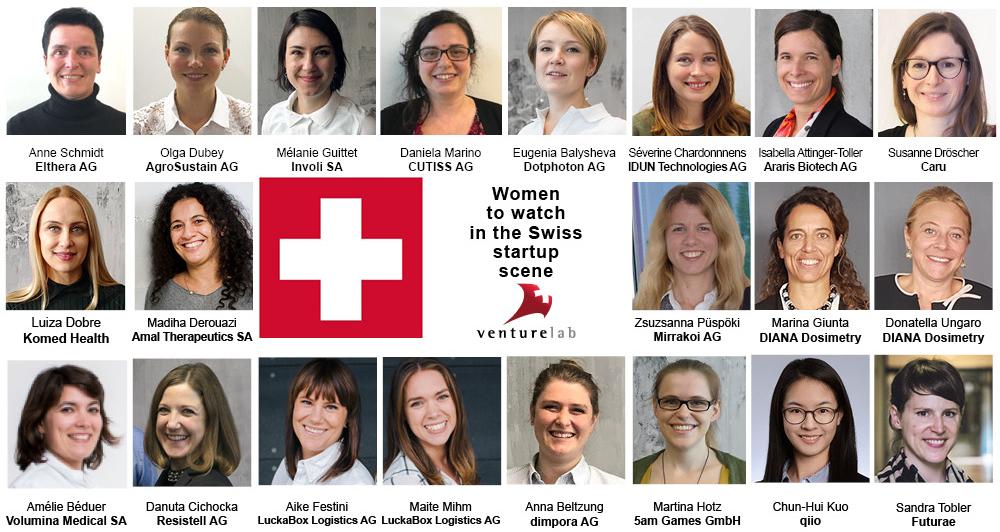
“But where are the women?!” It’s a question being asked ever more often, from Switzerland to Silicon Valley. There is no avoiding it: the tech industry around the world is heavily male-dominated.
And the lack of female faces becomes a self-perpetuating problem. Women who don’t see themselves represented may not be attracted to the industry; some report being pushed out by a hostile environment. The result? Not only women lose out. Businesses are tapping only half the talent pool. And products are being designed that don’t consider the needs of half of the population – think of how early airbags, designed for taller male bodies, were fatal to some women and children.Edith Schmid, COO of Kenzen and former president of the ETH Entrepreneur Club, elaborates: “If you are not confronted with people experiencing life in a different manner (whether this be different genders, or handicapped people, or refugees), you run into danger of pursuing a way of working, an idea, even an ideology, which does not address the needs of these people – or even worse: causes harm.”
Melanie Kovacs, founder of the Master21 tech education organization, recently announced winner of the Female Innovation Recognition Award 2018 and one of the Forbes 30 Under 30, agrees. “As with any area that lacks diversity (it’s not just tech), companies who don’t include women and other minorities miss out on talent, diverse views, better products, higher profits – and ultimately fun.”
So how do we increase diversity? “Talking about it is a start,” says Edith. “Acting upon it is the next step. Investors have, for example, started looking for diverse teams in startups. Organisations actively supporting women in business build networks and create platforms for exchange. What is more difficult to address is: How can we create a space – especially in the tech scene – where women feel comfortable pursuing a career? How do we get ‘tech = male’ out of the heads of especially young women?”
The experience of women who have already dived in is encouraging: many describe a startup community that is warm and welcoming to all. “I never felt underestimated as a woman,” reports AgroSustain founder Olga Dubey. “The entrepreneurial environment in Switzerland is extremely open and friendly.” In the Venture Kick program, for example, 25% of founder teams include at least one woman.
Edith agrees that she does not feel discriminated against as a woman in tech, but comments: “I notice how people realising that I am an ambitious woman sometimes treat me with mistrust. 'What is this woman’s agenda? Why is she so career-driven?' I do think that ambitious, successful women can instil fear, whereas ambitious, successful men are simply considered powerful.”
We at Venturelab have chosen to explore this topic with a series of profiles over the summer. As Edith says: “I want to be an equal in business and society. I refuse to see being a woman as a problem – and neither should the discussions around gender.” We agree; so we will be listening to a range of entrepreneurs tell us their stories – their challenges and successes – and share advice for female founders. And we are kicking off with a round-up of startup women to watch in Switzerland.

.jpg)
Clockwise from top left: Olga Dubey, AgroSustain; Madiha Derouazi, Amal Therapeutics; Lea von Bidder, Ava; Giovanna Davatz, Arktis Radiation Detectors; Eugenia Balysheva, Dotphoton; Sandra Tobler, Futurae; Isabelle Ohnemus, Eyefitu; Séverine Chardonnens, IDUN; Corinne John, Redbiotec; Bettina Ernst, Preclin; Sabrina Badir, Pregnolia; Dorina Thiess, Piavita; Sandra Neumann, Peripal; Mona el Isa, Melonport; Deborah Heintze, Lunaphore; Aike Festini & Maite Mihm, Luckabox.
Olga Dubey, AgroSustain (biotech; Venture Kick, AIT)
Olga’s passion to reduce the use of harmful pesticides has led her to discover an effective plant-based treatment that can fight damage from fungal pathogens both pre- and post-harvest – ie, it is as helpful in reducing food waste as in increasing production.
Madiha Derouazi, Amal Therapeutics (medtech; TOP 100, Venture Leader, Venture Kick)
Madiha’s University of Geneva spin-off also has a proprietary technology for tackling cancer. KISIMA combines an effective delivery system (a cell-penetrating peptide) with a potent anti-cancer payload.
Giovanna Davatz, Arktis Radiation Detectors (nuclear; Venture Leader, TOP 100)
Arktis’s technology for detecting radioactive substances – and therefore prevent trafficking of nuclear materials and improve security at airports and elsewhere – has won the firm high-level customers in both Europe and the US, and attracted $10 million in investment.
Lea von Bidder, Ava (medtech; Venture Kick, Venture Leader, Swisscom Startup Challenge, TOP 100)
The 2017 winner of the TOP 100 has been going from strength to strength in its four short years. Their attractively designed sensor bracelet tracks women’s menstrual cycles and provides data that can be used to boost the chances of conception – that may be a narrow goal, but they have hit it exactly, attracting thousands of users, millions of dollars of investment, and an array of awards. And earning Lea a place on the Forbes 30 under 30 list – the only one from Switzerland in 2017.
Eugenia Balysheva, Dotphoton (imaging; Venture Kick, Venture Leader, Swisscom Startup Challenge finalist)
As a professional photographer, Eugenia knew the pain of having her imaging ambitions constrained by file size – as a startup founder, she’s solving that problem. Dotphoton’s quantum-inspired, quality-preserving RAW image compression has benefits ranging from consumer mobile photography to space research, and has been featured on CNNMoney and the front page of AGEFI.
Isabelle Ohnemus, Eyefitu (consumer app)
Isabelle was a Merrill Lynch broker with a passion for fashion before her frustration with inconsistent sizing across brands motivated her to launch Eyefitu. The intelligent app is integrated with hundreds of brands to offers more choice as well as more reliable sizing, and has been recognised in multiple fashion and tech awards.
Sandra Tobler, Futurae (cybersecurity; Venture Leader, Venture Kick)
As a former trade commissioner for the Swiss government in San Francisco, Sandra is well placed to understand what makes an ICT startup succeed. And since she co-founded two-factor authentication firm Futurae just two years ago, the ETH spin-off has garnered attention from market watchers at Wired, Engadget, Gizmodo and TechCrunch.
Séverine Chardonnens, IDUN (biotech; Venture Leader, Venture Kick)
On IDUN’s own website, Séverine is described as “a CTO with people skills” – definitely a valuable asset! Together with fellow ETH student Simon Bachmann, she saw an opportunity in the trend toward wearable devices and developed a soft, elastic silicon-based electrode that offers greater comfort with clinical-grade signal quality.
Edith Schmid, Kenzen (biotech)
Kenzen's high-precision wearable sensors are pioneering health monitoring through sweat analysis, making it possible not only to determine a subject's current health, but even to prevent injuries in the workplace or in sport. Kenzen won the NFL's 1st and Future award in 2016 and has been featured in Forbes and the Wall Street Journal.
Aike Festini & Maite Mihm, Luckabox (internet; Venture Kick)
With not one but two female founders, logistics platform Luckabox is riding high. The Uber-style model is easy to understand – online retailers use it to offer their customers fast and flexible delivery, provided by independent couriers – yet innovative enough to have won the first ever European Supply Chain Startup Contest in May.
Deborah Heintze, Lunaphore (medtech; Venture Kick, Venture Leader, TOP 100)
Recent collaborations with medical imaging firm PerkinElmer and researcher and manufacturer Vitro underline the speed with which Lunaphore’s revolutionary tissue-staining diagnostics device is gaining ground – and gaining attention for Deborah, who is featured in the Forbes 30 Under 30. And the prototype isn’t even on the market yet.
Melanie Kovacs, Master21 (education)
The Master21 organization started out as a coding academy but is rapidly growing into something much broader - always with the same goal: to empower non-techie professionals with technical skills and understanding, in a supportive environment. And 60% of the student body is female.
Mona El Isa, Melonport (fintech)
In her former career as a banker, Mona was featured on two hot “30 under 30” lists – in Trader magazine as well as Forbes. She co-founded Melonport, a digital asset management toolbox, in 2016, after seeing the potential of blockchain for the finance industry.
Sandra Neumann, Peripal (medtech; Venture Leader, TOP 100)
Peripal’s innovative patient aid device simplifies the process of dialysis for patients treated at home, saving thousands in healthcare costs and improving the patient’s experience and safety.
Dorina Thiess, Piavita (medtech; Venture Leader, TOP 100)
Piavita falls in the unusual category of “pettech”, with its high-precision wearable vital signs monitoring device for horses. The devices are used in post-operation recovery as well as for early detection of health problems, and the data gathered forms a powerful in-depth horse health database. With Silicon Valley investors participating in the $5.5m Series A funding, US market entry is planned for later this year.
Bettina Ernst, Preclin (medtech; Top 100, Venture Leader, Venture Kick)
Bettina’s early experience in immunology research, in the US as well as Switzerland, led her to found Preclin Biosystems – an in vivopreclinical testing platform for the development and validation of therapeutics against chronic inflammatory and infectious diseases.
Sabrina Badir, Pregnolia (medtech; Venture Leader, Venture Kick, TOP 100)
Sabrina received the De Vigier entrepreneurship award in 2016 for her diagnostic device which predicts the risk of premature birth during routine checkups.
Corinne John, Redbiotec (medtech; TOP 100)
ETH spin-off Redbiotec’s cancer-busting technology has so much promise that its own spin-off Redvax was bought by Pfizer in 2015. The company continues to work on flu and herpes vaccines as well as its immune-oncology platform, which targets the hard-to-defeat cancer stem cells. Corinne was a De Vigier Award recipient in 2007, the year after she co-founded Redbiotec.
Now start your own adventure
Melanie Kovacs’ advice to women wanting to launch a project is simple: “Go for it. Do something you enjoy, you’ll find your way and leave a mark.”Here are some ways we can help:
- Free training and workshops with Innosuisse
- Up to CHF 130,000 from Venture Kick
- A desk or a meeting room in startup space
- Incorporation of your company with IFJ
- Become a member of the Swiss National Startup Team