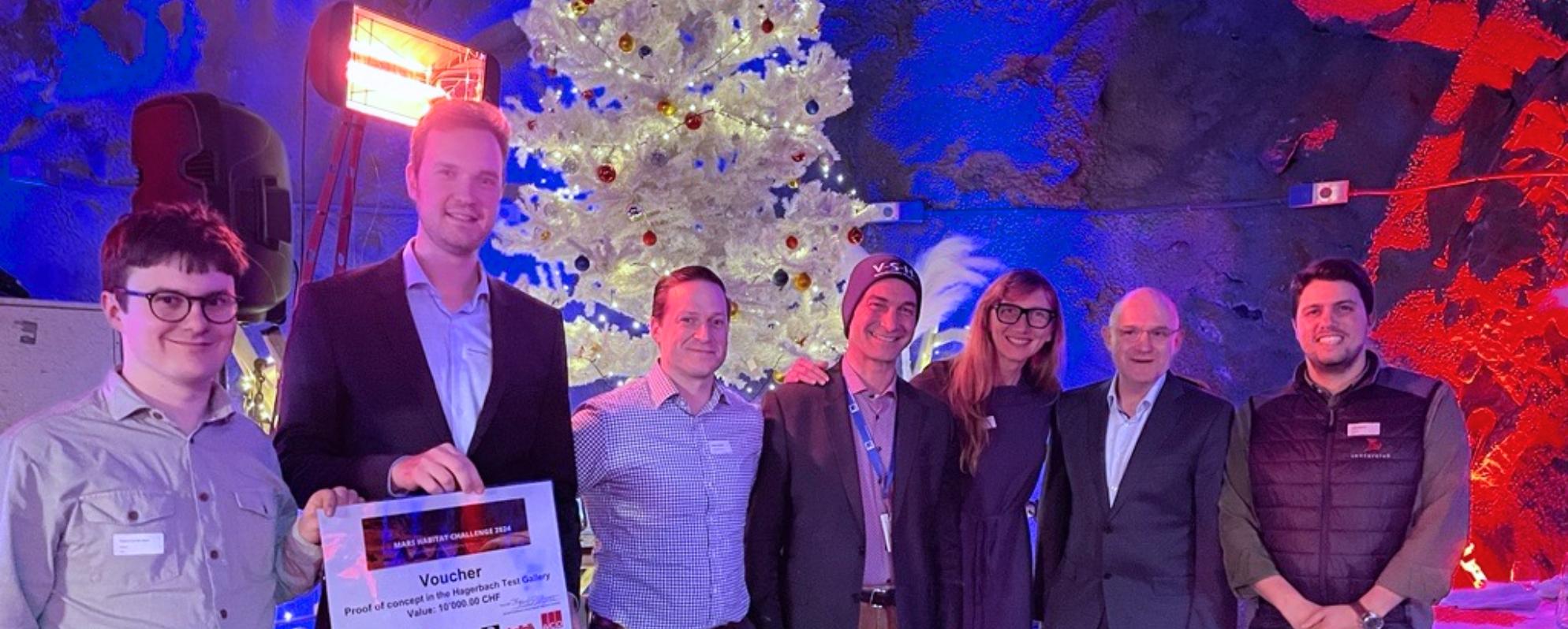
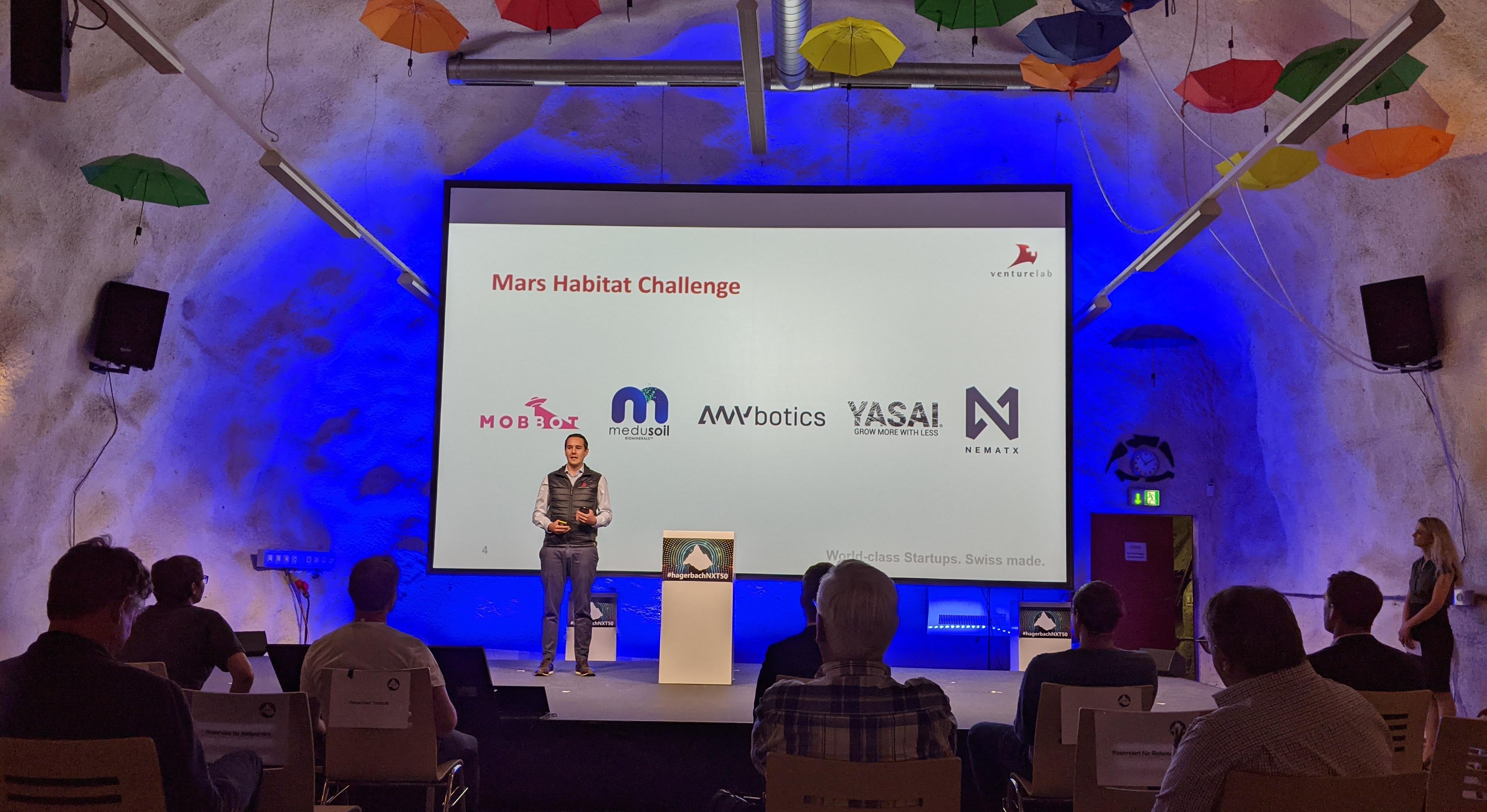
To find out more about the potential of life in outer space, we need to go underground: Mars Habitat Challenge is looking for pioneering startups to develop solutions and business models that help create a self-sustaining habitat on Mars or other planets. To do that, the startups will collaborate with Hagerbach Test Gallery, a network of tunnels and caverns that create the ideal underground research laboratory and training base for innovative projects based on a circular economy.

We talked to Felix Amberg, the president of Amberg Group AG, which provides global solutions in above and underground construction and owns Hagerbach Test Gallery. In our interview, Felix Amberg told us about the goal of the Mars Habitat Challenge, the types of solutions that he is looking for, and his plans for living on Mars.
 Felix Amberg, what is the mission of the Hagerbach Test Gallery?
The Hagerbach Test Gallery was initiated 50 years ago to provide a 1:1 environment for research and development, testing and prototyping, and training and education, mainly for the tunneling and mining industry. Today, the network of tunnels and caverns of various sizes extends over a length of about 5 km. Even though the facility houses entire operational units—such as building materials testing laboratory, restaurant, seminar/conference rooms, museum, shooting range, and event rooms—a large part is still available as a construction site, training facility, and prototype park, and its activities go far beyond pure construction technology aspects. With the increasing global urbanization, space becomes more and more precious in urban areas. The underground space below cities could provide attractive solutions for a lot of usages, which smart cities need, yet don’t want to allocate space at the surface.
 On June 18, Versuchsstollen Hagerbach AG will be a partner of the Mars Habitat Challenge. What are your expectations for the event?
 The event is part of the NXT 50, our 50th-anniversary celebration. If one thinks of extraterrestrial challenges, such as life on the Moon or other planets, the development and use of subterranean space get new impulses. Life on other celestial bodies in our planetary system must necessarily take place underground because of the high radiation, and it needs to be sustainable and circular since only a few resources—with low weight and self-sufficient operation, as there are no gas stations and power taps—can be transported there. If one works out such solutions, one must comprehensively test them first on Earth. Everything must function once on a planet since repair or maintenance is not that simple. Of course, the innovations can and should be used on Earth—there is no reason not to use the solutions first on Earth. On the contrary—not make use of sustainable solutions down here? In the age of climate change, every possibility in this respect is more than welcome! This strategy promotes innovation for solving our challenges on planet Earth in two ways: Sustainable and circular and underground—a growing global population that lives mainly in urban areas, this is a fascinating perspective.
We hope that the Mars Habitat Challenge will help us bring awareness to the topic and position Versuchsstollen Hagerbach as an incubator with the ideal network and environment for developing and working on and prototyping relevant solutions. We also want to stimulate the greatest possible interest from the startup ecosystem and attract international publicity and media attention.
 And why the focus on Mars?
 Space flight is perceived as innovative technology and a living environment. The focus on this environment is based on the logic we just talked about, and it positions Hagerbach as an innovation incubator for the construction and the use of underground space. Key stakeholders, including NASA and Elon Musk, have formulated the goal of creating a settlement on Mars by 2030, so Mars is THE next big destination for space travel. And the fact that we reach out to Mars to help us develop innovations for our future on Earth is a thrilling combination of two not yet well-known spaces: outer space and underground space. We reach out and combine frontiers for a new way of living!
What kind of startups should apply for the pitch event?
We are looking for companies with innovative solutions for sustainable technologies and utility concepts in underground space with closed loops. Solutions include those that offer products/services that could make life on Mars possible. Be it solutions for constructing buildings, health and safety, living, transportation, food production, or communication. The ultimate goal is a self-sustaining habitat based on the principles of a circular economy.
What does a startup or idea need to have to be one of the five winners?
To be among the winners, startups need to demonstrate technical know-how, a sense of reality, an urge to implement and be solution-oriented toward the outlined topic.
Last but not least: Would you want to live on Mars?
No, for me, it’s all about the here and now, where we need solutions for a world worth living in tomorrow.