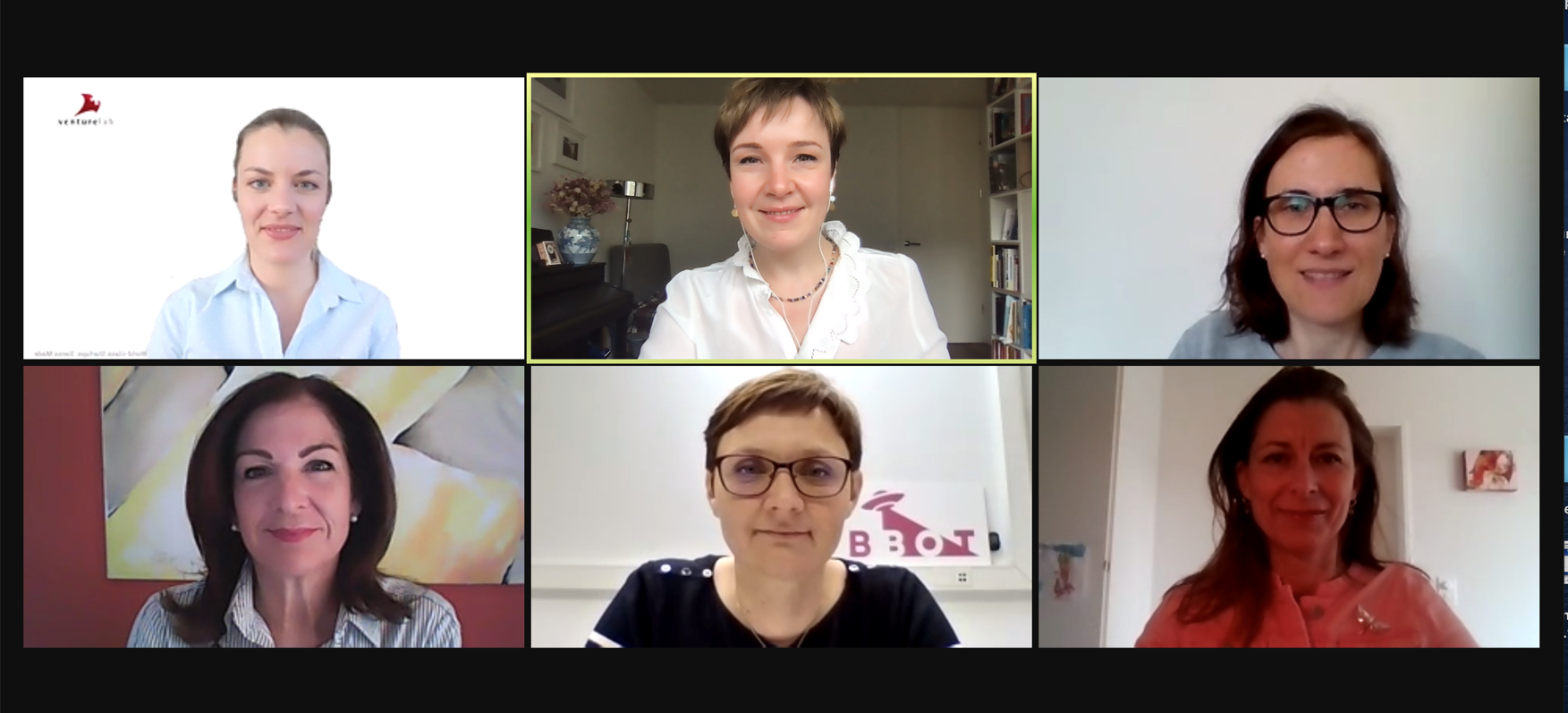
International Women’s Day offers an opportunity to look at the women shaping Switzerland’s startup landscape. In deeptech, healthcare, and life sciences, female founders are translating research and technological breakthroughs into companies that create long-term value. They lead teams, secure funding, navigate regulatory complexity, and bring scientific innovation closer to real-world application.
Their presence in early-stage innovation is becoming increasingly visible. According to the Venture Kick Annual Report 2025, 42% of supported projects include at least one woman in the founding team. This figure reflects a measurable shift in Switzerland’s science-driven startup ecosystem.To understand the people behind these developments, Venturelab spoke with Murielle Schreck, CEO and co-founder of the ETH spin-off qCella; Nour Abassi, CEO and co-founder of the EPFL startup DigeHealth; Emily Thompson, CEO and co-founder of the Bern University of Applied Sciences spin-off Pace Locator; and Michelle Keller, CEO and co-founder of the ETH spin-off Pure-DEL. They spoke about the decisions that brought their companies to life, the challenges they faced along the way, and the changes they hope to see in the ecosystem. A common theme emerges: building a startup requires both personal determination and supportive structures.
Which decision changed everything for you as a founder?
Murielle Schreck:
"All my life, I knew what I wanted to do next: studying at ETH Zurich, writing my Master’s thesis abroad, and pursuing a doctorate. Then, through an accidental discovery of a new material combination, I was faced with an unexpected opportunity. I could either continue toward academia or a corporate career or turn my back on that path and pursue something highly risky, with only a small chance of success: becoming an entrepreneur. I never regretted that choice!"
Nour Abassi:
"The decision was to leave my job and build. It wasn’t one isolated decision. It was something that kept intensifying over time. I was progressing, delivering, and growing, but I could no longer ignore the gap between what I was doing and what I truly wanted to work on. I had long believed that healthcare cannot remain episodic. We still assess patients at isolated moments while physiology evolves continuously.
As that belief became clearer, the distance between my daily work and what I felt committed to only grew. And it started to feel personal. Eventually, staying no longer felt aligned with who I was becoming. So I left, and started this journey."
Michelle Keller:
"During my PhD, my colleagues and I had the idea of Pure-DEL technology and worked very hard to implement the platform. Our vision was to establish a technology capable of generating collections of millions to billions of pure synthetic macrocycles, opening the door to discovering drug candidates for challenging and previously 'undruggable' disease targets. When I finished my PhD, after we had established the platform, I realized that if my colleagues and I stopped working on the technology, it would probably just remain an academic discovery and not translate to the point of real drug candidates."

What did no one warn you about when starting your company?
Murielle Schreck:
"I always wanted to build my own team, but I did not expect how difficult it is to not only build it but cultivate it. Now, after initial struggles, I am extremely proud of our amazing team and what they have achieved in a very short time."
Emily Thompson:
"When I started my company, I underestimated how much the work consumes you. I don’t think anyone ever really discussed how difficult it can be to turn the work off even when you leave the office, since so much of the work is just always in my head. There’s an immense pressure as a startup founder to always be in the 'hustle' mindset and it is surprisingly challenging to turn that off in my free time."
Michelle Keller:
"Founding a startup in pharma, there is a lot of uncertainty. There are many challenges on the way. An important point I learned is to try to address problems in a fast and pragmatic way so you can move forward."
Where do you see the key strengths of female founders and what should women remind themselves of in everyday startup life?
Nour Abassi:
"What I often observe, and try to cultivate myself, is the ability to remain steady when things feel messy. Startup life is rarely predictable. There is noise, uncertainty, conflicting information, and decisions that never feel fully comfortable. The capacity to stay calm in that environment, to think clearly without rushing or panicking, makes a real difference.
And I think many women founders combine that steadiness with genuine care. Care for the mission, care for the people involved, care for doing things properly.
That balance matters because it allows you to stay composed without becoming distant and to care deeply without becoming overwhelmed. In complex environments, that kind of leadership builds trust and durability."
Emily Thompson:
"One of the key strengths of female founders is the fact that we tend to have an advantage when it comes to open communication and emotional intelligence. I believe these traits are critical for building strong teams and managing people in high-stress environments. Women should remind themselves that strong leadership is fundamentally about building relationships and to stay confident that their skills are deserving of the role."
Which mistakes should women consciously try to avoid when building a startup?
Murielle Schreck:
"I do not believe in labeling founders or entrepreneurs by gender. Becoming and succeeding as an entrepreneur requires a specific mindset including resilience, courage, and persistence. These qualities are not defined by gender. At the same time, some women may feel discouraged because of past experiences or bias. These challenges are real, but they do not limit your potential. Do not let societal bias define your path."
Nour Abassi:
"One mistake I see is waiting for perfect readiness. You rarely have complete certainty when building something meaningful. Acting and adjusting is part of the process.
Another is carrying too much alone. Growing a startup requires delegation earlier than feels comfortable.
And finally, do not dilute yourself to fit expectations. Leadership is not performance. It is consistency in standards and ownership of decisions."
Michelle Keller:
"I think it is important to not let challenges coming your way unsettle you too much. It is important to stay pragmatic: to make a plan and follow it, and if necessary, to adapt the plan."
What are you particularly proud of today?
Murielle Schreck:
"I am particularly proud of the team we have built, the remarkable progress we achieved in a short time, and the strong balance we maintain between hard work and genuinely enjoyable time together."
Nour Abassi:
"What I am most proud of is the belief that brought this team together and continues to move it forward. We started without guarantees and with many unknowns. Still, people chose to commit. They joined not because it was comfortable, but because they believed in the vision. That kind of alignment is intentional and rare.
And the need is real. When you speak to patients, you immediately understand how much episodic care leaves unresolved. That reality gives depth and urgency to what we are building.
At this stage, what makes me most proud is that shared conviction, grounded in a real need and carried collectively."
Emily Thompson:
"I’m particularly proud of the confidence I’ve built throughout the startup journey. When I started, I struggled with imposter syndrome constantly. Nowadays, I feel much more comfortable with the title of Founder & CEO and I think a lot of that can be contributed to the success I’ve had with fundraising and keeping the company afloat through a significant technology pivot."
Taken together, these perspectives show that entrepreneurship is neither defined by gender nor free of challenges. It demands clarity, resilience, and the willingness to act before certainty is guaranteed. As more women step into leadership roles across Switzerland’s science-driven startups, the ecosystem grows stronger, more diverse, and better equipped to turn innovation into lasting impact.
Related articles
Voices of women founders in the Swiss startup ecosystem on International Women's Day
read more
International Women's Day 2024: Celebrating females in Swiss startups
read more
International Women's Day 2023: Resources for innovators and aspiring entrepreneurs
read more.jpg)
International Women’s Day 2022: How to better negotiate in the Swiss startup ecosystem
read more